


According to World Bank estimates, Ukraine’s total recovery needs exceed USD 588 billion. The construction sector is one of the largest sources of CO₂ globally, accounting for approximately 34% of energy-related emissions. This raises a question that is not strictly technical in nature: what materials will Ukraine build with, and what does this mean for access to international financing.
It was precisely this issue that FSC Ukraine placed at the centre of the academic debate at the international scientific and practical conference “Forest Sector Transformation towards Ukraine’s Post-War Green Rebuilding: Meeting Changing Demands for Professionals,” held on 19–20 April 2026 at NULES of Ukraine.
FSC Ukraine has presented a report on the role of forest certification in financing low-carbon construction. Pavlo Kravets, FSC Ukraine National representative and researcher at the Ukrainian Research Institute of Forestry and Forest Melioration named after G. M. Vysotsky, together with Yevhenii Khan (NULES of Ukraine, FSC Ukraine) shifted the conversation on certification from the educational to the investment dimension.
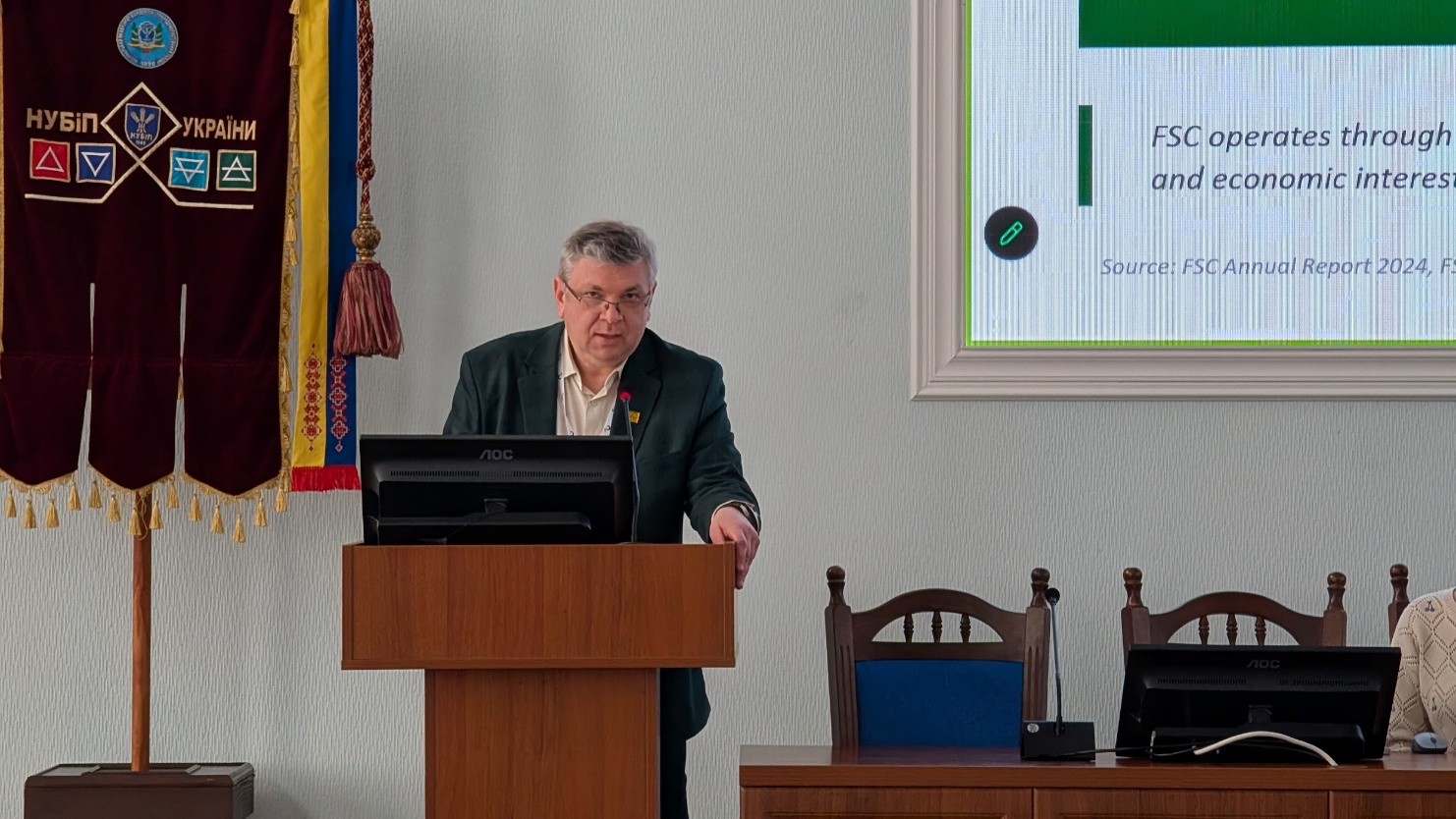
Experts focused on the materials Ukraine will use for construction and what this means for access to international funding.
Mass timber structures, including CLT and glulam, can significantly reduce embodied carbon compared to reinforced concrete, while storing the carbon absorbed by trees in buildings for decades and even centuries. However, for timber to meet the requirements of green finance, independent verification of responsible forest management is needed. FSC certification converts forest management data into standardised assurances recognised by the EU Taxonomy, green bond frameworks, and leading asset managers such as BNP Paribas, Mirova, and Mobilising Finance for Forests.
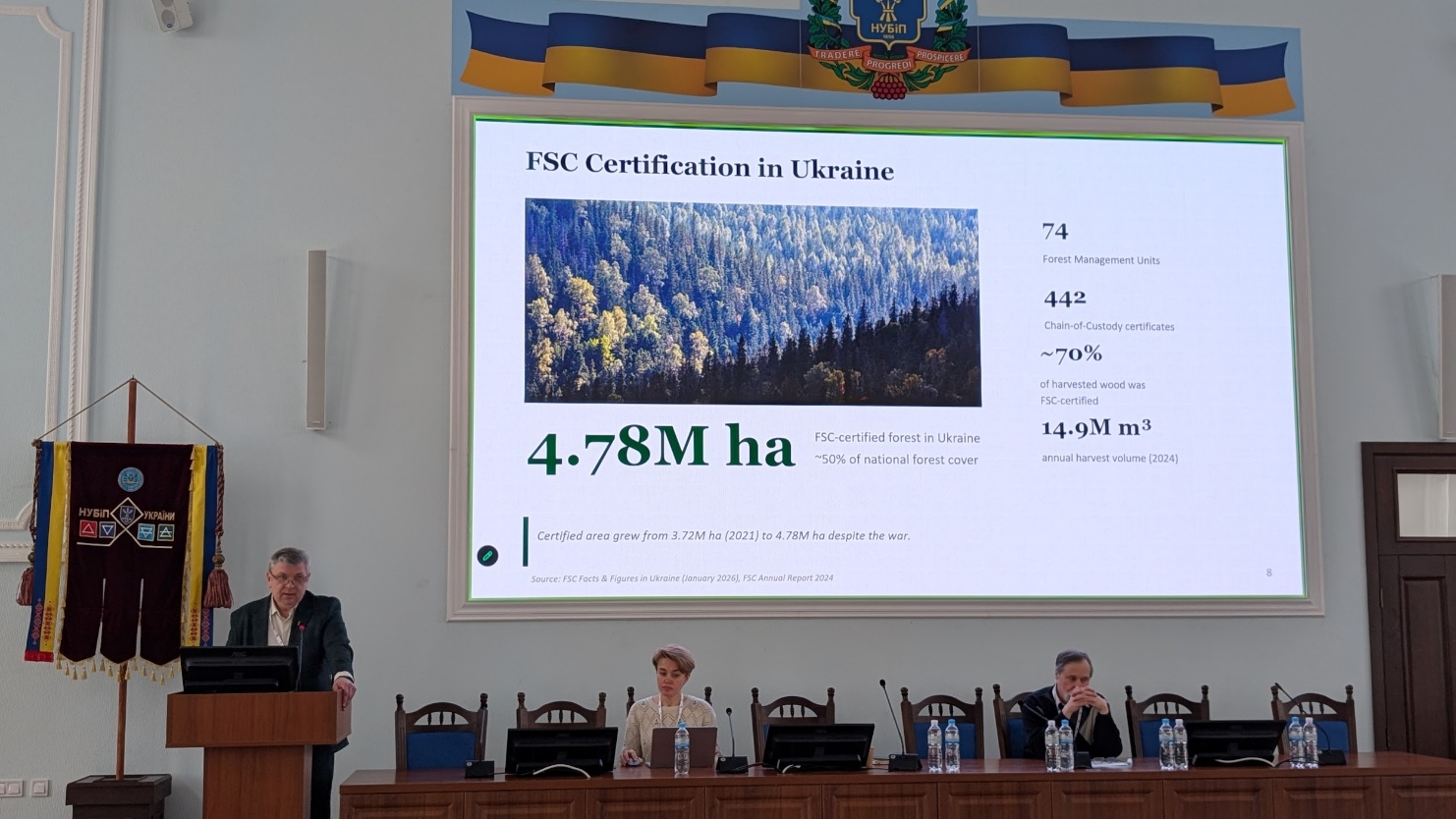
Despite wartime conditions, the area of FSC-certified forests in Ukraine has grown from 3.72 million hectares in 2021 to 4.78 million hectares at the beginning of 2026, approximately 50% of the country’s forest fund. Over 70% of harvested timber is FSC-certified, and the number of active chain of custody certificates exceeds 440. “We demonstrate that despite the emergency, these principles and requirements are upheld. This is our contribution and at the same time a signal to international partners about the opportunities for investing in the forest sector,” – noted Pavlo Kravets.
On its path to EU membership, Ukraine must harmonise over 200 legal acts in the environmental sphere. The EU Taxonomy and the revised Energy Performance of Buildings Directive (EPBD, 2024/1275) already link access to green finance with verified sustainability of materials – therefore, the availability of independent assessment of timber sourcing becomes not only an environmental but also an economic asset for a candidate country.
The presentation also featured information on wood construction projects implemented in Ukraine the CLT extension of the “Unbroken” National Rehabilitation Centre and the construction of a hospital in Lviv designed by architect Shigeru Ban using domestically produced CLT. Both projects are being implemented in the context of the core ideas of the New European Bauhaus, a European Commission programme that supports sustainable solutions in construction and the urban environment, of which FSC is a partner.
Speaking before an audience of educators and researchers, Pavlo Kravets emphasised the responsibility of universities for the quality of professional discourse: “Researchers and scientists should play a greater role in developing balanced solutions by bringing a culture of dialogue grounded in objective data, research findings, and evidence-based arguments into the discussion. This will contribute to the development of Ukraine’s forest sector as part of the European Union already now.”
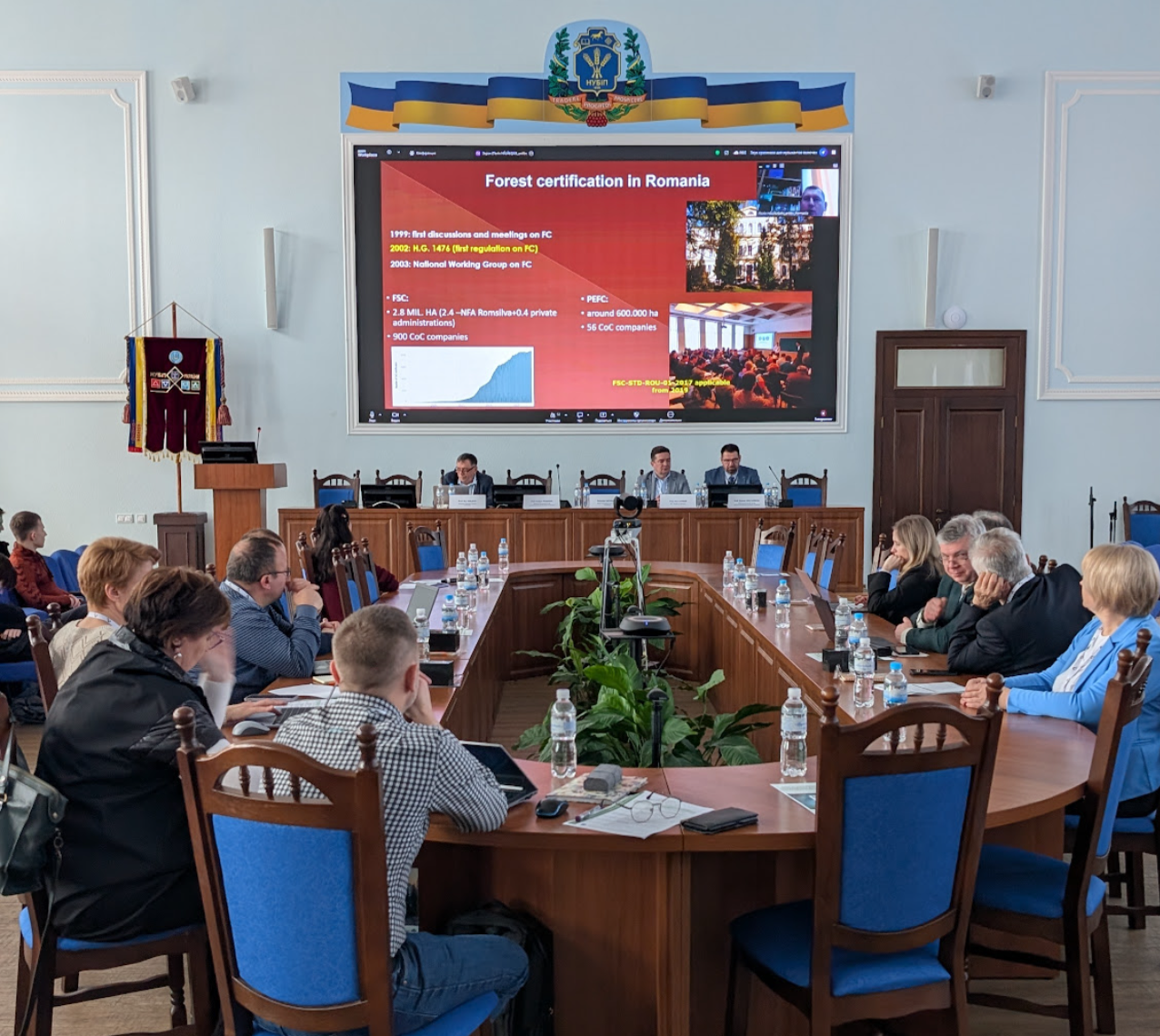
The topic of forest certification was raised at the conference twice. Professor Florin Hălălișan from Transilvania University of Brașov (Romania) shared the experience of integrating FSC and PEFC certification into the Master’s programme in forestry. Students learn to work with standards directly: they simulate audits, analyse documentation of forest enterprises, and visit certified forests. Romania has come a long way from its first steps in 2002 to over 2.8 million hectares of FSC-certified areas today and this experience shapes the modern curriculum.
The conference brought together researchers, educators, representatives of the State Agency of Forest Resources of Ukraine, SFE “Forests of Ukraine,” international partners from Germany, Romania, Spain, and Sweden, as well as students – the future forestry professionals. The event was dedicated to the International Day of Forests, observed in 2026 under the theme “Forests and the Economy”.