


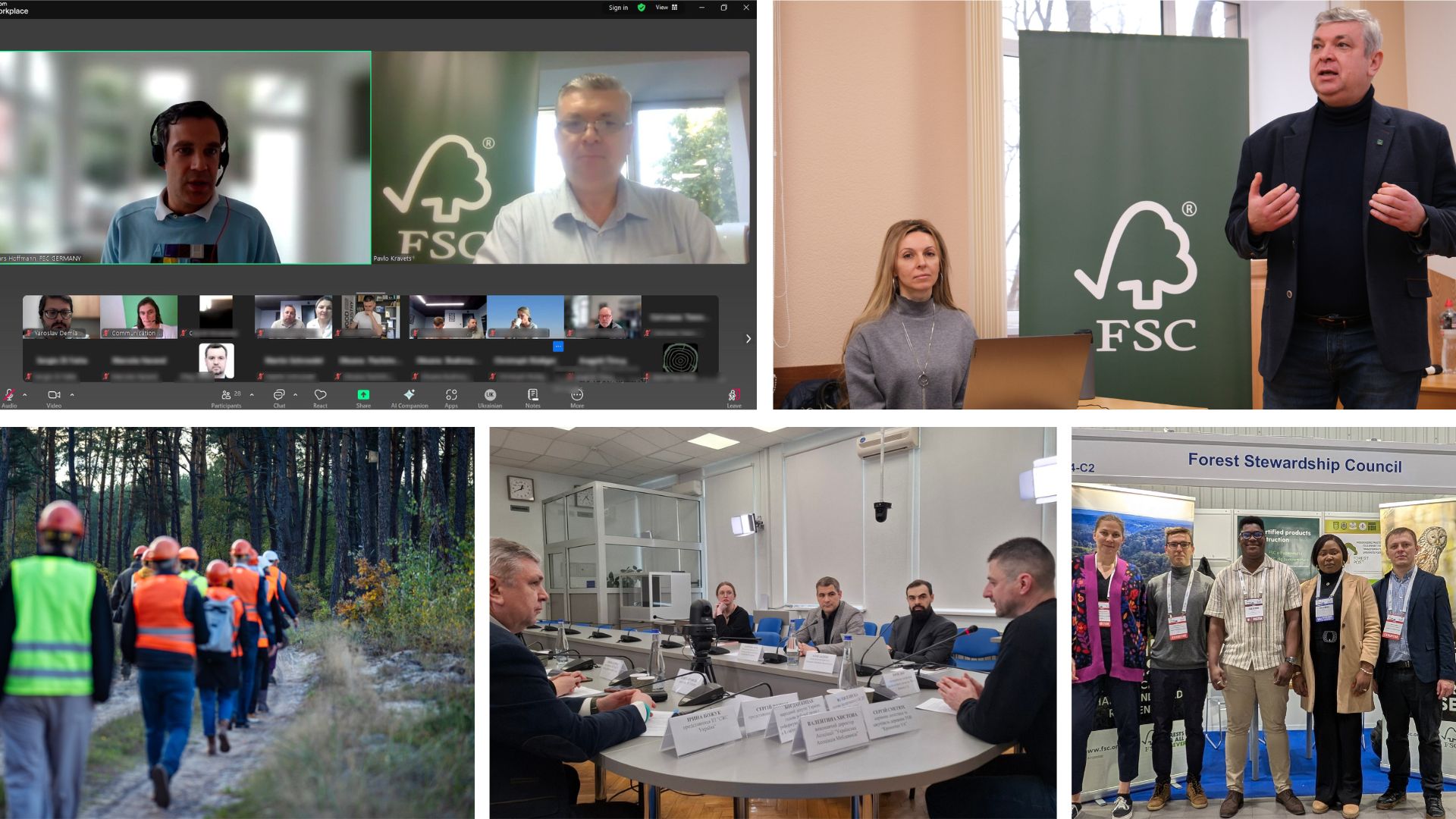
The third stage of the forest reform had just concluded, raising questions about maintaining certification for the subdivisions of the SFE "Forests of Ukraine." FSC Ukraine's proactive stance in ensuring the continuity and integrity of supply chains contributed to find a solution. Interpretation of FSC International provided comprehensive guidance for all participants in the certification process and confirmed the possibility of preserving the organization's mission amid continuous changes.
The impact of forest reform in the context of FSC certification proved vital for maintaining the supply chains of the forest industry business, specifically at least 400 companies. At the end of January, at their initiative, stakeholders gathered at a roundtable to demonstrate commitment to FSC values and prevent possible negative consequences of the reform. The meeting addressed not only wood supply but also changes in forest management philosophy, improving production culture, and ensuring high environmental and social standards in forest management.
Economic activity is important, yet the FSC Forest Stewardship Standard for Ukraine requirements regarding environmental values remain fundamental. Therefore, in May, the FSC Ukraine team completed what it had been working on for three years. Based at one of the newly formed Forestry Management Units of the Carpathian Forest Office, FSC Ukraine conducted a seminar on best practices in responsible forest management according to the FSC FSS for Ukraine. It brought together those who manage 4.65 million hectares of certified forests – almost half of Ukraine's entire forest area. Significantly, it was the certificate holders themselves who demonstrated and exchanged experience on best practices for preserving environmental values, evidencing the integration of standard requirements into the forest management system.
During the summer, the FSC Ukraine team confirmed with numbers what it believes: despite extraordinary conditions, the certification system works even when everything seems to be against it. At the international Expo "Woodworking", we demonstrated that 17% growth in the number of certificates in Ukraine within a year is achievable. And when we spoke online with colleagues from FSC Germany in July, we understood: they were looking not at statistics but at people who, despite everything, remain true to themselves, conducting and developing business in the face of adversity.
In autumn, the FSC Ukraine team decided to show the journey each certified timber product takes – from seed to building. The media tour led journalists, architects, and designers from the forest seed center in Lviv region to the CLT panel building of the Unbroken National Rehabilitation Center. Participants recognized the imperative of low-carbon construction and became full participants in professional dialogue about Ukraine's reconstruction needs and challenges, learned how it works here and now at an already certified enterprise, and experienced the role of foresters firsthand by planting a new forest.
FSC Ukraine's achievements extend beyond the national context. In Panama, during the General Assembly – FSC’s highest decision-making body – members from Ukraine shaped FSC's development roadmap for the coming years alongside 800 colleagues from around the world. Representatives of the FSC Ukraine Advisory Committee presented strategic proposals for engaging local communities in FSC certification under martial law conditions. The Advisory Committee's experience did not go unnoticed by the international community.
Concurrently, in November, FSC Ukraine brought together at a roundtable those who often speak pasy each other: developers, government officials, architects, and civil society activists. Through discussion, participants reached a common conclusion that green reconstruction is not a choice between ethics and economics but rather what creates competitive advantages.
The international FSC team promoted this same idea at the ReBuild Ukraine 2025 International Exhibition. Representatives from Ukraine, Poland, the Baltic countries, and FSC International specialists held dozens of meetings with one goal: through FSC values, to bring together everyone who can help with reconstruction, enable them to establish professional connections, and find reliable partners.
The end of 2025 became a time not only for annual summaries but also for completing longer-term projects. While in previous years the standards development working group had worked on systemic solutions to reduce risks associated with armed conflict zones, embodied in Annex J to the FSC FSS for Ukraine, in December a training on its implementation took place. A clear mechanism has been developed for enabling excision of areas contaminated by explosive objects from the scope of certification without losing status for the remaining areas. However, this unique solution, which may be useful not only for Ukraine but for any post-conflict country in the world, is impossible without changes in certificate holders' management systems.
For consistent change in the philosophy of responsible forest management, it is important that all stakeholders are aligned and build cooperation based on FSC's mission. A series of webinars with Fredrik Backlund emphasized the most important point: partnership begins with truly hearing the other's needs. Throughout the year, the FSC Ukraine team tested this in practice: conducting more than a dozen seminars and trainings on the most important aspects of responsible forest management, strengthening supply chains integrity, and engaging in certification to build trust. Finally, the government's decision to increase the area of certified forests by 10% by 2027 is both recognition of the effectiveness of the work done and a prerequisite for further growth and strengthening of FSC for Ukraine's future.